
Ellis County Projected Versus Actual
“Projected Release Date” is TDCJ's exact field. Classification and Records calculates it as the date incarceration is projected to end if parole does not happen sooner. It is not a promise, a rewrite of the court sentence, or proof that a past release occurred. Offense date, offense type, mandatory-supervision rules, credits, and later case action can affect it.
A scheduled release date appears after favorable action and processing advances, yet it can still change. An actual release or discharge date is historical. Parole eligibility only marks when legal consideration may begin. A next review date follows an earlier Board decision. Maximum sentence date marks the sentence endpoint reflected by TDCJ. Keeping these labels apart prevents a projection from being reported as a completed event.
A pretrial Wayne McCollum or Ennis detainee ordinarily has no computed TDCJ date. Bond can authorize release while the case continues, but jail staff must still check other causes and holds. A signed order may also precede physical departure.
Find Ellis County Release Dates
Choose the system from the person's actual custody path. The TDCJ offender search applies after entry into state prison or a Texas state jail. The Ellis County live roster is a current-custody list and does not display an actual release field. A county sentence must be checked with the jail record and sentencing cause.
- Match the person with at least two identifiers. TDCJ number or SID gives the cleanest state match; county records use local inmate and booking numbers.
- Decide whether the person is pretrial, serving a county sentence, in TDCJ, or held for another agency.
- For TDCJ, open the detail and copy each label exactly: projected release, maximum sentence, parole review, and any scheduled or actual event.
- For a county sentence, obtain the judgment, jail-credit record, and Wayne McCollum calculation for that cause.
- Check detainers, consecutive causes, and receiving agencies before treating any date as final.
- For a past county event, use the Ellis County release-record process to obtain the actual movement transaction.
The official TDCJ email information page documents a fallback when the web result is incomplete.
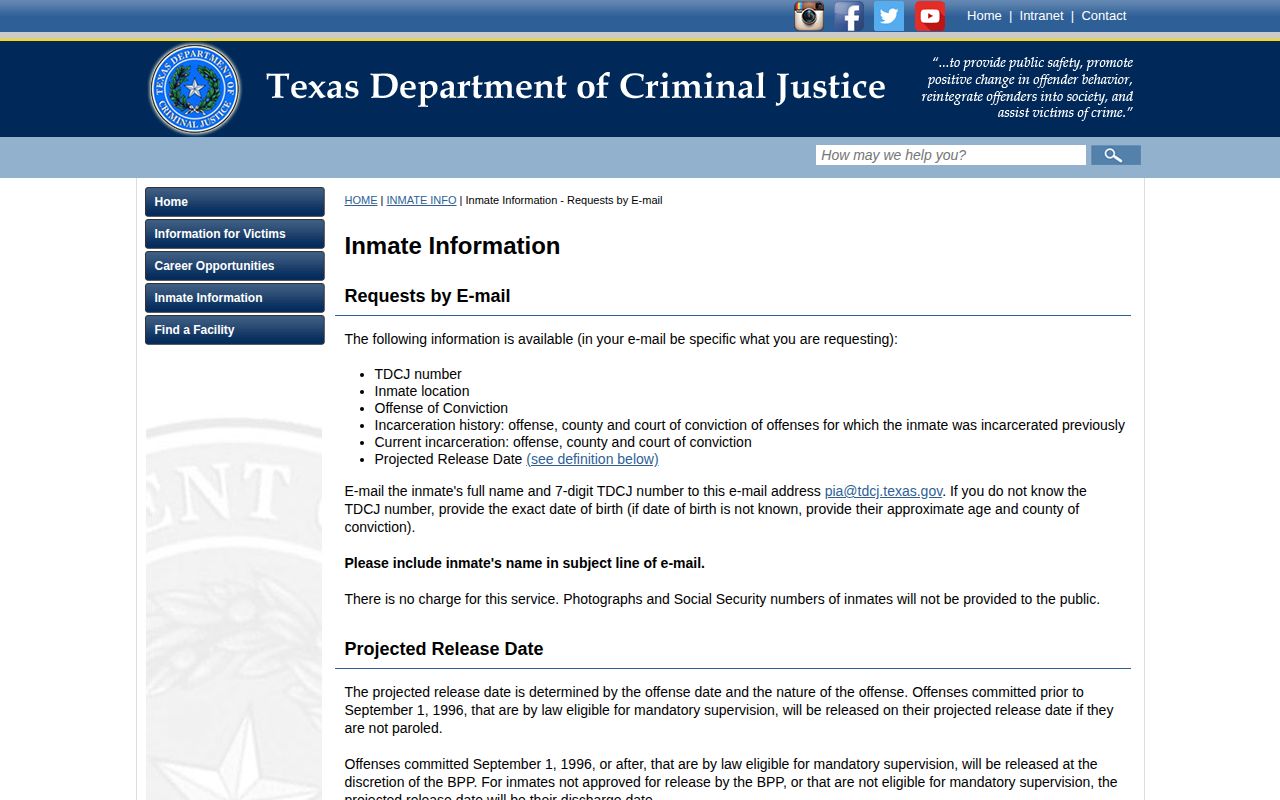
A request should include the full name and seven-digit TDCJ number. Without that number, provide exact birth date or approximate age and county of conviction, then ask for the specific projected or actual release information.
TDCJ Ellis County Date Fields
The TDCJ form accepts last and first name, TDCJ number, SID number, sex, and race. A detail may include current facility, offenses, sentence data, projected release date, maximum sentence date, and parole-review information. Its value depends on whether the person truly entered TDCJ. It is not the correct first source for a Wayne McCollum stay that ended by county bond or time served.
| Date or status | Meaning |
|---|---|
| Parole eligibility | When consideration may begin under applicable law |
| Next review | A later Board review marker after a decision |
| Projected Release Date | TDCJ calculation if parole does not occur sooner |
| Scheduled release | Planned processing date after favorable action |
| Actual release/discharge | Completed historical event |
| Maximum sentence date | Sentence endpoint reflected by TDCJ |
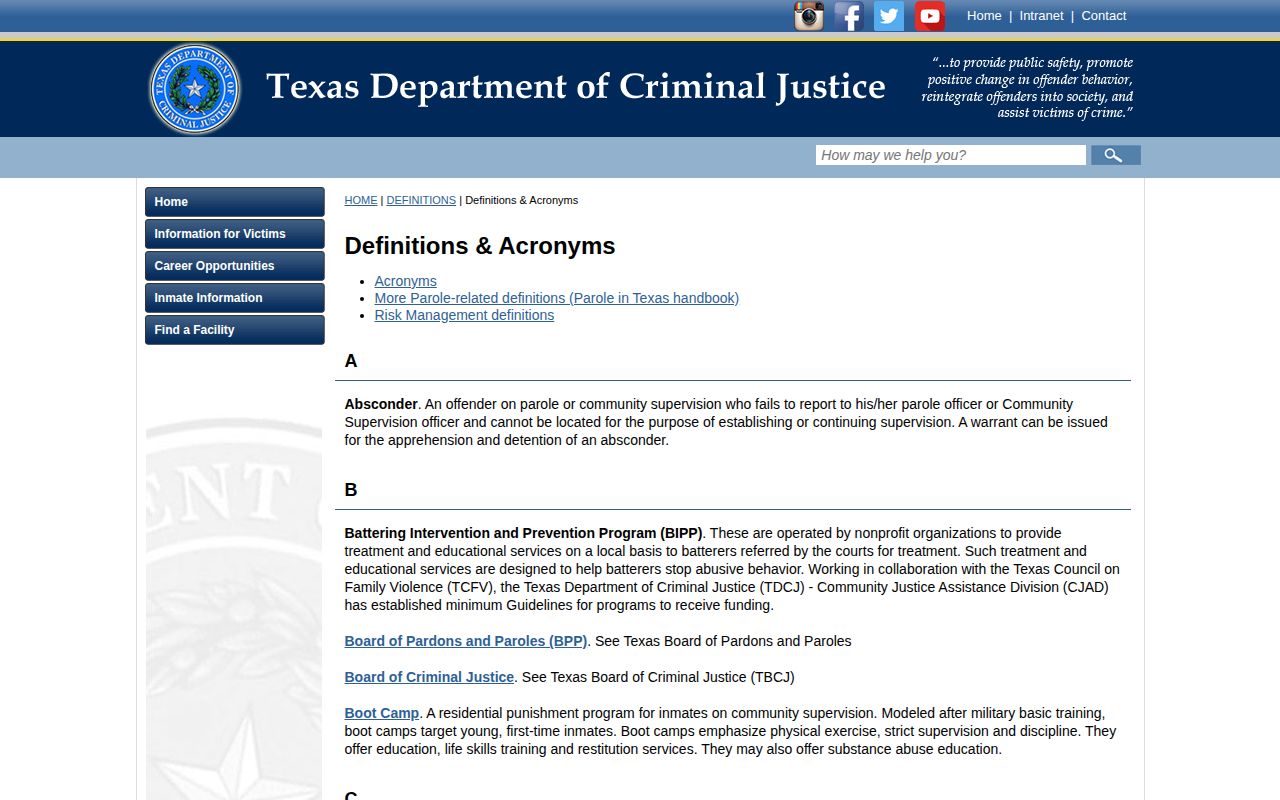
The TDCJ definitions explain projected dates and releasee terms.
Use the agency's label and date rather than a homemade calculator. A detail can change after a Board action, credit change, or records audit.
Ellis County Good-Time Rules
Texas Government Code chapter 498 governs TDCJ good-conduct time. These administrative credits can affect classification and release-eligibility calculations, but generally do not reduce the sentence pronounced by the court. Credits may be forfeited. Their effect depends on offense date, offense, sentence, and legal status.
For mandatory-supervision-eligible offenses committed before September 1, 1996, TDCJ explains that flat time plus good time may equal the sentence and lead to mandatory-supervision release if parole has not happened. For eligible offenses on or after that date, the Board must approve discretionary mandatory supervision. A denial can move the projected date to maximum expiration, while later approval may recalculate it earlier.
Texas has no universal rule requiring every prisoner to serve 85 percent. Government Code section 508.145 sets parole-eligibility categories and contains restrictive calculations for some serious offenses. Section 508.149 excludes listed categories from mandatory supervision. Some familiar Texas thresholds involve one-half of the sentence or 30 years, whichever is less, but other categories differ. Never apply one percentage to an individual record.
Eligibility turns on the law in effect on the offense date. Death and life-without-parole sentences are not parole eligible. The TDCJ calculation and sentencing documents should control over a generalized estimate.
Ellis County Jail Date Calculation
A Wayne McCollum sentence is not calculated in the TDCJ public search. Texas Code of Criminal Procedure article 42.032 lets the sheriff in charge of a county jail commute time for good conduct under the sheriff's classification and rules, subject to statutory exclusions and limits. “Commute” here means lawful reduction of the time to be served under that county framework, not cancellation of the conviction.
The named episode may also include credit for time held before sentence, concurrent or consecutive causes, disciplinary history, and another agency's hold. Obtain the judgment and the jail's own calculation. A bond amount is not a release date. Nor does disappearance from the current roster establish why or where the person moved.
Ennis municipal custody has its own route. A qualifying Class C matter can resolve by exact cash or money order, an eligible bond, time served through jail credit, or a combination. Felony and other misdemeanor bond matters may route to the Ellis County Sheriff bond desk instead. Transfer to Wayne McCollum is continued custody, not a community release.
Weekend Ellis County Sentence Release
Texas Code of Criminal Procedure article 42.033 can permit a qualifying sentence discharge on the preceding weekday when the calculated discharge falls on a Saturday, Sunday, or legal holiday, subject to the statute. This rule belongs to sentence discharge. It does not automatically move a bond release, court-ordered release, or transfer forward.
That distinction matters locally because Texas has two release-date regimes: TDCJ's state calculation and the county sheriff's good-conduct authority. A person may also be held on a second cause or for a receiving agency. Before arranging a pickup, confirm the exact event with the responsible facility. Wayne McCollum publishes no fixed release hour or public exit, so a calculated weekday should not be turned into a promised pickup time.
Article 42.033 also does not establish a rolling list of weekend releases. Ellis County publishes no official 24-hour or 72-hour release feed. The completed Sheriff movement record remains the proof of what happened.
Why Ellis County Dates Change
A projected date is recalculated when the facts or legal rule used in the projection change. Some events move it earlier. Others move it later or replace release to the community with transfer to another custodian.
| Factor | Possible effect |
|---|---|
| Board vote | Approval, denial, or later review changes release processing |
| Mandatory-supervision decision | Approval may permit release; denial may move projection to maximum |
| Credit forfeiture | Lost credits can delay the calculation |
| New sentence or corrected jail credit | Records staff recalculates from corrected legal data |
| Detainer or hold | Another authority may take custody instead of community release |
| Program prerequisite | Release can await required treatment or programming |
| Release-plan approval | An incomplete or rejected plan can delay departure |
| Records audit | Classification and Records may correct the displayed date |
A detainer is notice that another agency seeks custody or action. It does not reveal the final outcome on its own. If an Ellis release record names TDCJ, federal, or immigration transfer, follow that receiving agency's locator.
Ellis County Parole Date Limits
Parole review does not create an actual release date by itself. Texas panels vote from case files rather than through a public calendar of formal initial hearings. A favorable code may authorize release when eligible, set a later date, or require treatment, programming, or an approved plan. The TDCJ detail and Board voting-code material must be read together.
After favorable action, release processing still checks prerequisites and holds. A projected date may remain visible while the scheduled date changes. A denial with a future review marker is also not a maximum sentence date. Keep the Board decision, TDCJ calculation, and completed departure as three separate facts.
Government Code sections 508.145 and 508.149 govern important eligibility and mandatory-supervision limits. They do not supply one quick formula for every Ellis County case. The offense date, sentence structure, and TDCJ calculation remain essential.
Confirm Ellis County Release Dates
For a state prisoner, TDCJ controls its projected and actual fields, while the Board controls the parole vote. For a county inmate, the Sheriff controls the completed Ellis County movement record, and the court controls the judgment and orders. Compare both when physical processing and legal action occurred at different times.
Texas IVSS can provide quick custody-change alerts. The current county route is VINELink Release Check through Texas IVSS-Counties, while TDCJ IVSS handles prison and parole events. An alert may lag and may show release from one custodian when another accepts the person. Reconcile it with the official record.
Identity matching is essential. Names, suffixes, and dates can be incomplete. Match full name plus birth information, or name plus the official TDCJ, SID, local inmate, or booking number. Then associate the exact cause. A correct date attached to the wrong person is not a valid result.
For a former Wayne McCollum inmate, request the actual date and time, release reason, releasing authority, and destination or receiving agency. For a state prisoner, ask TDCJ for incarceration history and actual release or discharge information when the public detail no longer supplies enough history. A court docket adds the legal event but may not capture the exact moment the facility finished processing.
TDCJ's email information service is a no-charge fallback, but the request must identify the person well enough for staff to find the right record. Include the seven-digit TDCJ number when known. Without it, provide the exact birth date or approximate age and the county of conviction. Ask separately for the projected date, maximum sentence date, parole review information, and actual release history so that one label is not mistaken for another.